

2026-09-21
Welded wire mesh is a prefabricated grid of steel wires resistance-welded at every intersection into a rigid, uniform sheet. It reinforces concrete, builds security fencing, forms animal cages, and guards machinery. But the mesh you need depends on three choices you must get right: mesh opening, wire diameter, and surface finish. Get any one wrong and the panel rusts early, bends under load, or fails a specification.
Welded wire mesh (also called weld mesh) is made by arranging steel wires in a grid and electrically welding them together at every crossing point. Because each joint is fused, the finished sheet stays flat and rigid rather than unraveling when cut — unlike woven wire mesh, which is flexible and better suited to screening.
The base material is low-carbon steel wire. On its own, that steel rusts quickly outdoors, so most welded mesh carries a finish — hot-dip galvanized, electro-galvanized, or PVC coated — matched to where it will be used.
Every welded wire mesh order rests on three core parameters. State all three clearly on your RFQ and you eliminate most sourcing mistakes.
Mesh opening is the clear distance between adjacent wires, written as width × height in millimetres or inches. Smaller openings block fingers and small animals but add weight and cost; larger openings use less steel and are cheaper per square metre.
Openings range from about 6.4 mm × 6.4 mm (1/4") for fine cages and guards up to 100 mm × 100 mm (4") for economy fencing. Workhorse sizes between them include 12.7 mm × 12.7 mm (1/2"), 25.4 mm × 25.4 mm (1"), and 50.8 mm × 50.8 mm (2"), plus rectangular openings such as 25.4 mm × 50.8 mm for fencing and guards.
Wire diameter drives tensile strength, rigidity, and price. Heavier wire makes a stiffer, more climb-resistant panel but is harder to handle; lighter wire is easier to work with but only for light-duty use.
Diameter is commonly specified in BWG (Birmingham Wire Gauge) or millimetres. Production typically spans BWG 24 (about 0.5 mm) for fine light-duty mesh up to BWG 12 (about 2.7 mm) for heavier galvanized panels. Galvanized welded mesh is frequently supplied in 1.65 mm, 2.0 mm, 2.11 mm, and 2.5 mm diameters depending on the opening.
Finish determines corrosion life and appearance. The three options buyers compare most often are:
Welded wire mesh is supplied as rigid panels (sheets) or as rolls.
The format affects both freight cost and on-site labour, so match it to how the mesh will be installed.
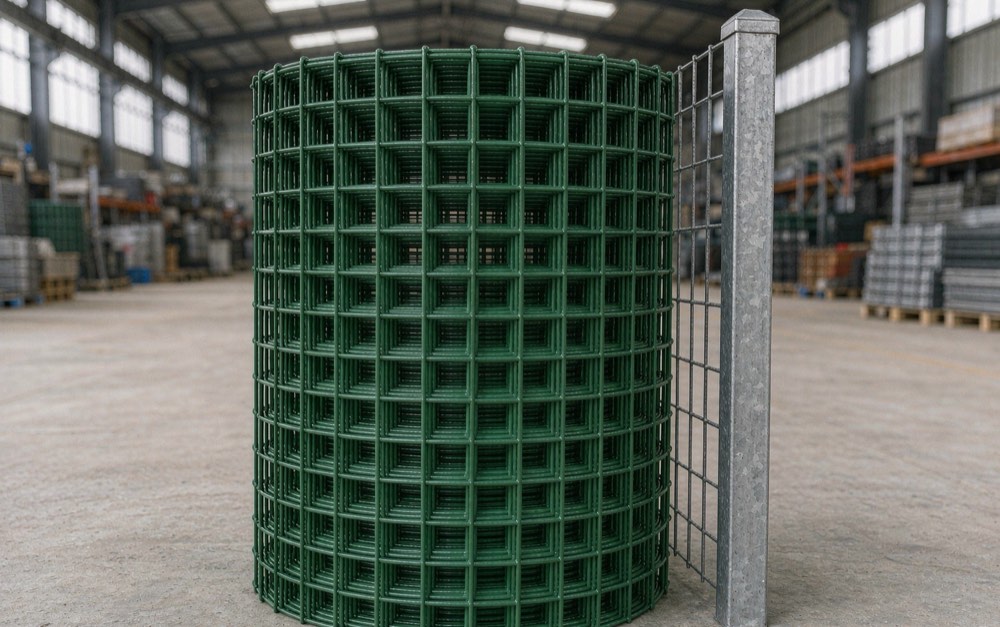
Three pitfalls come up repeatedly in welded wire mesh RFQs, and each costs time and money:
A complete welded wire mesh inquiry lets a supplier quote accurately the first time. Include:
Which finish should I use for an outdoor fence?
Hot-dip galvanized. The zinc covers the weld joints and gives the longest outdoor service life. PVC coating adds colour and extra protection where appearance or coastal exposure matters.
Panels or rolls — which should I order?
Panels for concrete and rigid fencing where flatness matters; rolls for long runs, cages, and enclosures where you want to cut to length on site.
View our Welded Wire Mesh product page.
Email robin@foccred.com.
Or contact us on WhatsApp.
<< Previous Page
Next Page >>

Tianjin Foccred International Trade Co.,Ltd.


Contact Us
Tel:+86 15210003531
Whats app:+86 15210003531
Wechat:+86 15210003531
E-mail:tim@foccred.com


Power by: cnwangju.com Sitemap
 +86 15210003531
 +86 15210003531
 tim@foccred.com
