

2026-10-05
Steel grating is the load-bearing flooring choice for industrial walkways, platforms, stair treads and trench covers. But choosing the wrong bearing bar size, pitch or coating can turn a cost-saving purchase into an early replacement project. This guide explains the specifications that matter, so buyers can order panels that fit the application the first time.
Steel bar grating is an open-grid flooring panel built from parallel bearing bars joined at right angles by cross bars, fixed by welding or pressure locking. The bearing bars carry the load; the cross bars hold spacing and keep the panel rigid.
The open-grid design delivers high strength at low weight, lets light, air and liquids pass through, and provides a naturally slip-resistant walking surface. That combination is why grating outperforms solid plate for most industrial flooring, drainage covers and stair treads.
For most industrial orders, welded grating is the default; press-locked suits projects where appearance and a flush surface matter.
The bearing bar — its height and thickness — decides how much load a panel carries over a given support span. Deeper bars carry more load: heights of 25–32 mm cover pedestrian walkways and stair treads, 40–50 mm handle heavier platforms and light vehicle traffic, and deep bars up to 75×8 mm serve heavy-duty areas such as ports and highway trench covers. Common stock sizes include 25×3, 30×3, 30×5, 32×5 and 40×5 mm.
| Application | Typical bearing bar | Typical pitch |
|---|---|---|
| Walkways, stair treads | 25×3 – 32×5 mm | 30 mm |
| Industrial platforms | 30×5 – 40×5 mm | 30–40 mm |
| Heavy duty, vehicle areas | 50×5 – 75×8 mm | 40–50 mm |
Pitch matters as much as bar depth. A 30 mm bearing bar pitch is the standard choice for pedestrian traffic, 40 mm is the economical general-purpose option, and wider pitches of 50–65 mm suit areas crossed only by wheels. Cross bar pitch is commonly 40–100 mm. When a deflection limit governs the design, tightening the pitch usually costs less than upsizing the bar.
Three bearing bar profiles are available: plain (F), serrated (S) and I-section (I). Serrated bars carry rolled saw-tooth notches along the top edge, and they bite into footwear underfoot.
Specify serrated grating wherever the walking surface sees water, oil, mud or ice — outdoor walkways, stair treads, offshore and wet process areas. Plain surface is appropriate for dry interior platforms and saves cost; I-section reduces panel weight where load requirements allow.
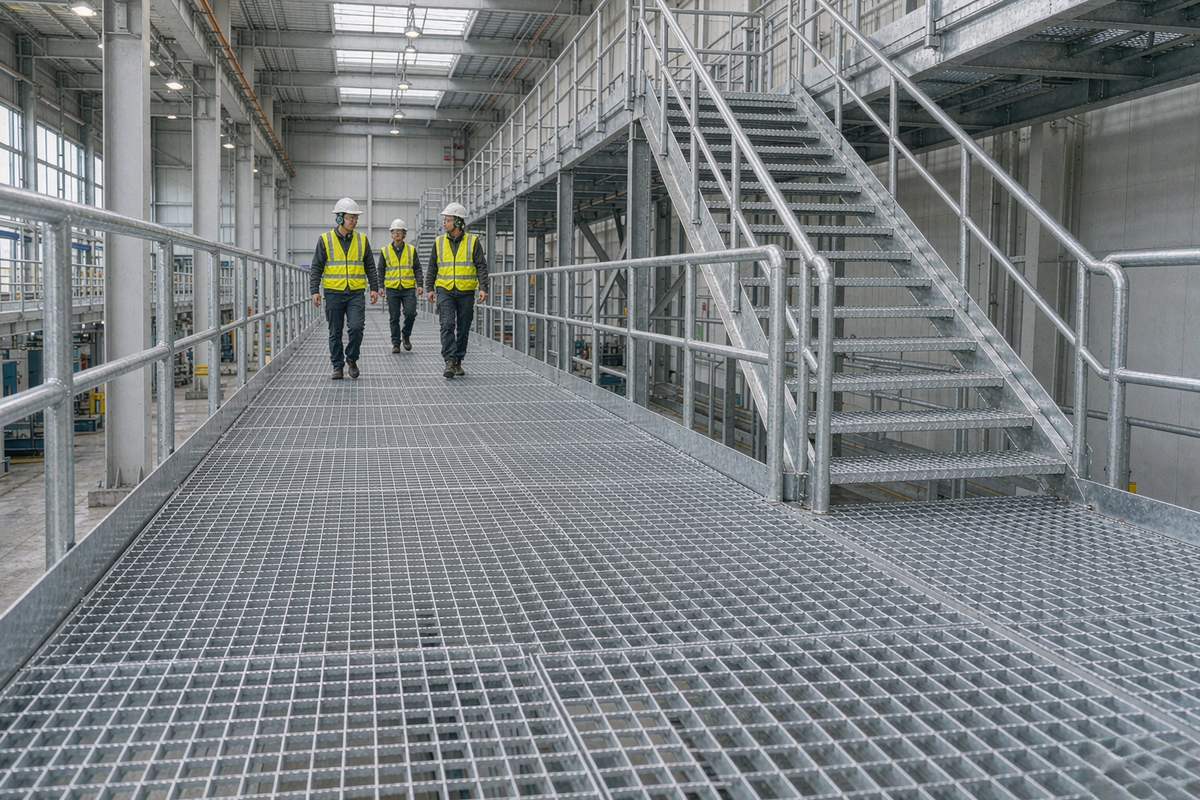
For outdoor or corrosive environments, hot-dip galvanizing is the default finish. Panels are immersed in molten zinc after fabrication, following established practice such as ASTM A123 and ISO 1461, so every bar, edge and weld point is coated — not just the visible faces. Cold-dip galvanizing, painting and powder coating suit milder or indoor conditions, while uncoated black panels are limited to temporary or indoor use. Where zinc is unsuitable — food processing or aggressive chemical exposure — stainless steel 304/316 grating is the alternative, and aluminium suits lightweight applications.
An uncoated carbon steel panel will rust quickly outdoors; hot-dip galvanizing is what turns Q235 grating into a long-service-life asset.
Send the support span, application, expected load, panel size, bearing bar size and pitch, surface type, finish and destination port. A complete RFQ returns an accurate quotation in one round instead of three.
Hot-dip galvanized steel grating with a serrated surface is the standard choice for outdoor walkways — the zinc coating resists corrosion and the notched bars maintain traction in rain.
FOCCRED supplies welded, press-locked and socket-welded steel gratings in Q235, stainless steel and aluminium, with hot-dip galvanized, painted, powder-coated or black finishes for distributors, contractors and project buyers worldwide.
View our Steel Grating product page.
Email robin@foccred.com.
Or contact us on WhatsApp.
<< Previous Page
Next Page >>

Tianjin Foccred International Trade Co.,Ltd.


Contact Us
Tel:+86 15210003531
Whats app:+86 15210003531
Wechat:+86 15210003531
E-mail:tim@foccred.com


Power by: cnwangju.com Sitemap
 +86 15210003531
 +86 15210003531
 tim@foccred.com
