

2026-11-12
Gabion wire mesh is the double-twisted hexagonal mesh that builders assemble into boxes, baskets and mattresses and then fill with stone on site. Because the double-twist lets the structure settle and flex without losing strength, gabions outperform rigid concrete in retaining walls, riverbank protection and slope stabilization. Specifying the right mesh size, wire diameter and coating is the single biggest factor in whether a gabion wall lasts 10 years or 50 years.
Gabion wire mesh is woven from steel wire into a hexagonal (double-twisted) pattern, then fabricated into cages of a set length, width and height with internal diaphragms. The mesh is delivered flat or as assembled baskets, filled with locally sourced stone, and laced shut on site. FOCCRED supplies gabion boxes from 100 × 30 × 30 cm up to 200 × 100 × 100 cm, with wire diameters of 3.5, 4.0, 4.5 and 5.0 mm and mesh openings of 50 × 50, 50 × 100, 75 × 75 and 100 × 100 mm, and all box sizes can be customized to project drawings.
The mesh opening must hold the fill stone, and the wire diameter must carry the wall load. A general rule: the mesh opening should be smaller than roughly two-thirds of the smallest stone diameter, and the wire diameter should increase with wall height and stone weight. For standard retaining walls and slope protection, a 3.5 mm wire with a 75 × 75 mm or 100 × 100 mm opening is common; for taller walls, heavy stone or high-energy river flows, step up to 4.0–5.0 mm wire.
Coating choice decides service life in wet and saline environments. Hot-dip galvanized wire is the economical standard for most river and slope work, and its zinc coating protects the steel core until consumed. For coastal, saline, acidic or high-moisture sites, add a PVC coating over the galvanized core — the polymer jacket adds a second barrier that significantly extends life in aggressive water. Specify PVC-coated gabions where the structure sits in salt water, industrial runoff or fast-flowing rivers.
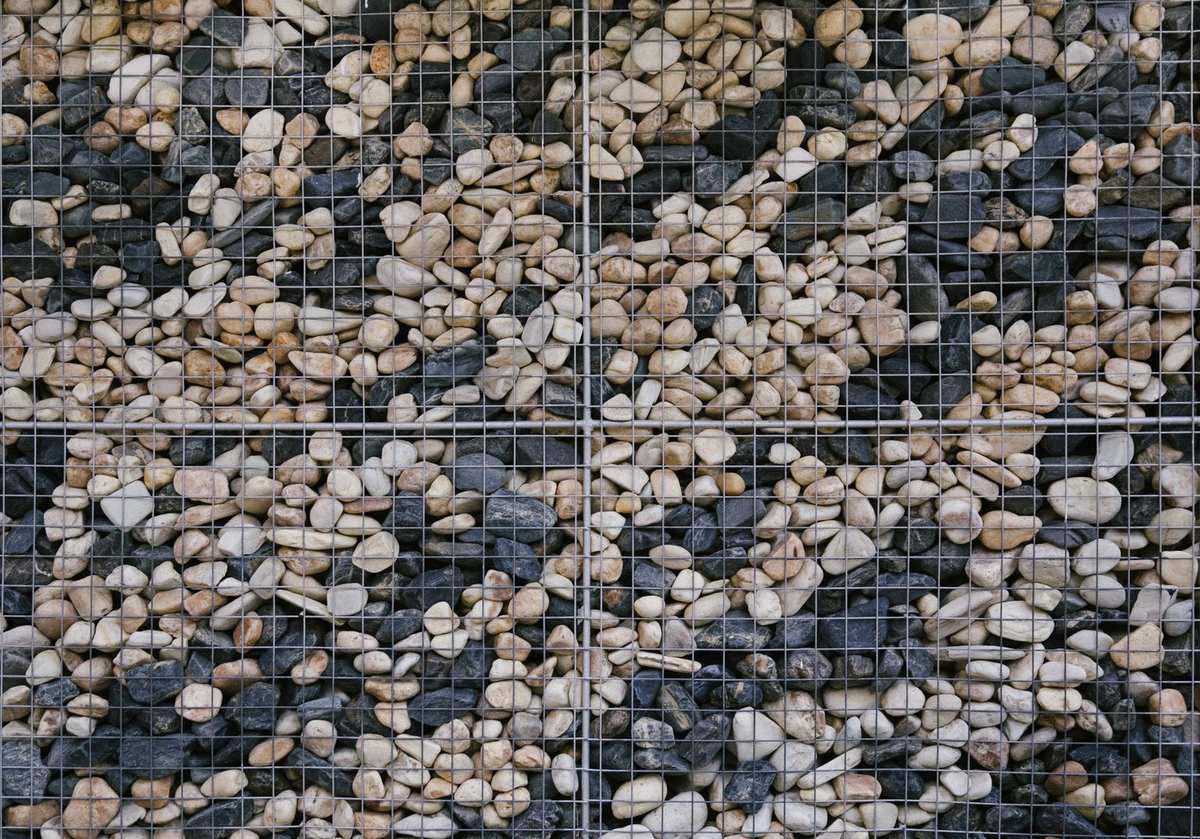
The key advantage is flexibility: a gabion wall can deform slightly as the ground moves and still hold, where a rigid concrete wall would crack. Gabions are also permeable — water passes through, reducing hydrostatic pressure — and they gain stability over time as stone interlocks and vegetation roots through the mesh. Because the fill stone is usually sourced locally, gabions are often the lowest-cost option for remote sites.
For a standard retaining wall, specify a 75 × 75 mm or 100 × 100 mm mesh opening with 3.5 mm wire, and step up to 4.0–5.0 mm wire for taller walls, heavier stone or high-energy water flow, keeping the mesh opening smaller than about two-thirds of the smallest stone diameter.
Choose hot-dip galvanized for most river and slope work as the economical standard, and add a PVC coating over the galvanized core for coastal, saline or high-moisture sites where a longer service life is required.
Standard gabion boxes range from 100 × 30 × 30 cm to 200 × 100 × 100 cm, with wire diameters of 3.5–5.0 mm and mesh openings of 50 × 50 to 100 × 100 mm, and all dimensions can be customized to your project drawings.
View our Gabion Wire Mesh product page.
Email robin@foccred.com.
Or contact us on WhatsApp.
<< Previous Page
Next Page >>

Tianjin Foccred International Trade Co.,Ltd.


Contact Us
Tel:+86 151 1006 9033
Whats app:+86 151 1006 9033
Wechat:+86 151 1006 9033
E-mail:robin@foccred.com


Power by: cnwangju.com Sitemap
 +86 151 1006 9033
 +86 151 1006 9033
 robin@foccred.com
